Ethereum Gas To Usd Calculator . Also check out our live makets in different exchanges. This is why are gas fees so high on a particular day and time. Trade Watchlist MATIC Uptrend Still in the Works? from www.babypips.com Sort words to an alphabetical numbered list tool; This gwei to usd calculator / converter takes in an amount of gwei, which is 1 billionth of an eth, and spits out the amount of usd based on current prices from coingecko. As the gas fees are denominated in gwei, the increasing price of ether would naturally increase the amount users have to pay for gas.
How To Calculate Excess Reagent. The remaining excess amount of this reactant is calculated as follows: This is called a back titration method.
Limiting Reactant Solution Stoichiometry from solutionstoichiometry.weebly.com
This chemistry video tutorial shows you how to identify the limiting reagent and excess reactant. The limiting reagent is the one that is totally consumed; 2na (s)+cl 2 (g)→2nacl (s) then we will calculate the molecular mass of each reactant.
A Method That Allows Identifying Which Is The Limiting Reagent, Based On The Comparison Of The Proportion Of The Reagents With The.
The first step in this problem is to find the number of moles of both reagents. Once you have identified the limiting reactant, you calculate how much of the other reactant it must have reacted with and subtract from the original amount. It shows you how to perform stoichiometric calculations an.
So You Can Still Verify That Zinc Chloride Is The Limiting Reagent While The Excess Reactant Is Magnesium.
Both are required, and one will run out before the other, so we need to calculate how much of both we have. I would first find the limiting reagent, which is clo 2 f. To calculate the excess reactant, firstly, we will balance the chemical reaction.
For Example, If The Balanced Equation.
Since we know the amount of reagent used in excess, we can determine the amount of it that reacted with the unknown component. So, the excess reagent is ammonia, and 57.5 g of ammonia. This calculation shows that 42.5 g of the original 100 g of ammonia will react before the limiting reagent is expended.
The Reactant Left Over When The Reaction Is Complete Is The Excess Reactant.
The limiting reagent is the one that is totally consumed; To determine the excess reactant, first determine the limiting reactant, as explained in the previous section. The limiting reactant or reagent can be determined by two methods.
Determine The Limiting Reagent If 100 G Of.
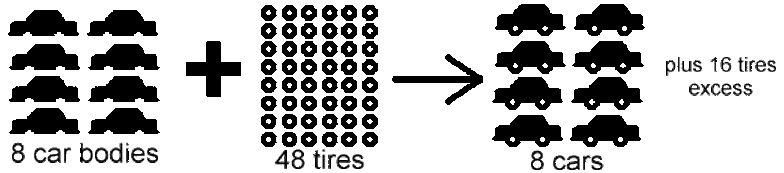
This chemistry video tutorial shows you how to identify the limiting reagent and excess reactant. The reagent that is completely used up or reacted is called the limiting reagent, because its quantity limits the amount of products formed. Let us consider the reaction.


Comments
Post a Comment